
lineages & History
Our growing suite of classes are rooted in a diverse watershed of wisdom traditions and embodiment systems from around the world that ground us in culture, authenticity, reciprocity, and care. We are deeply nourished by the root-stalks of these lineages as we also strive to nurture a space for the creative emergence of living forms and practices that are both informed by and distinct from our cultural and ancestral roots.
On this page you can read more about the lineages and histories from which our work draws upon.
Jump to section:
Mitsui Movement
Mitsui Martial arts
Lotus Kajukenbo
Tai Chi
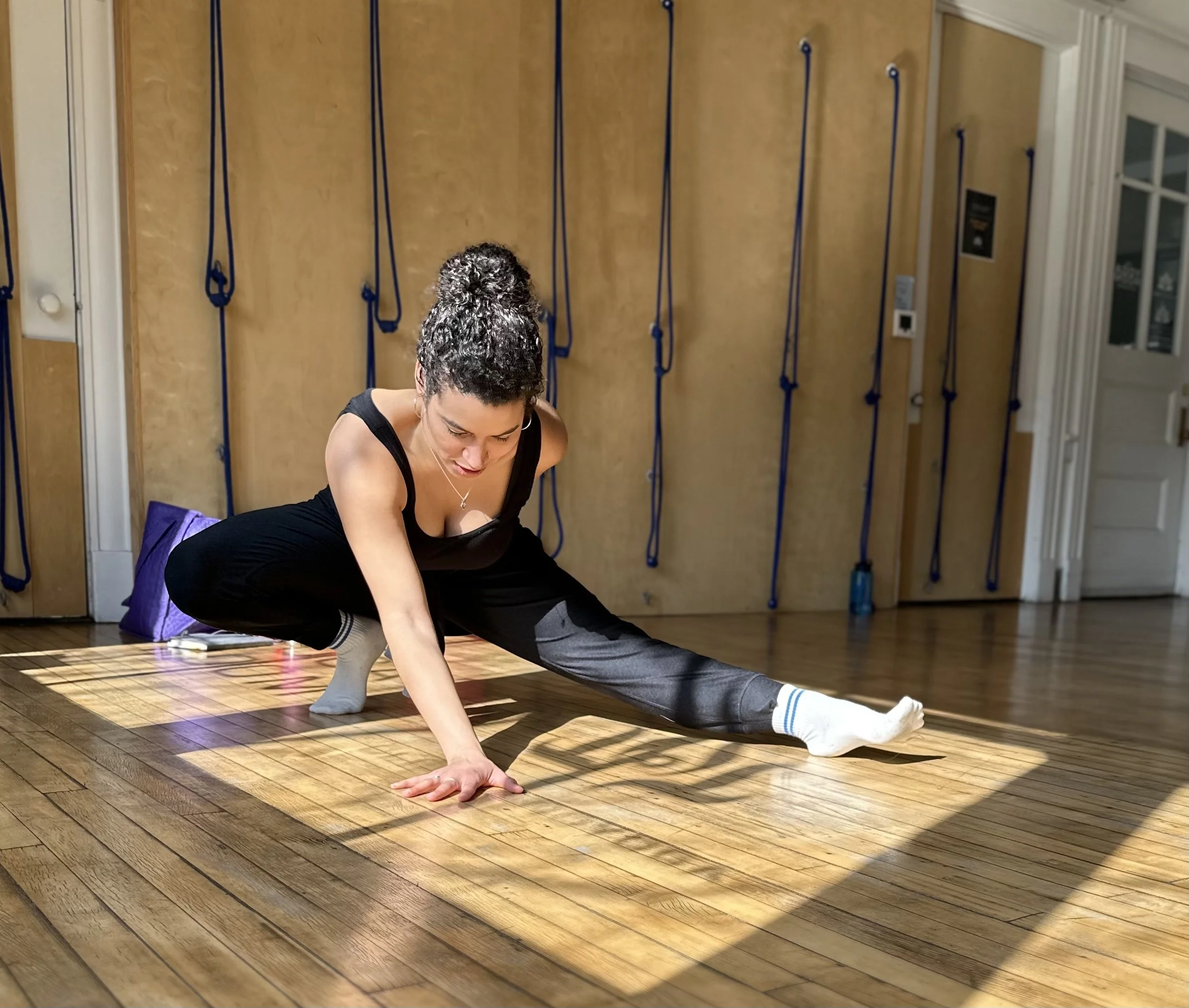
Mitsui movement
Mitsui Movement is a core element of Mitsui Method, a system of embodied Jewish alchemy created by Yoshi Silverstein. While the forms, frameworks, and expressive qualities of Mitsui Movement are unique, a number of embodiment systems, lineages, and teachers have deeply informed the development both of Mitsui Method broadly and Mitsui Movement specifically.
Key influential methodologies and schools include:
Generalist Movement Pedagogy — such as the work developed by Ido Portal, Marcello Palozzo, Shai Faran, Linda Kapetanea and Jozef Frucek, and more — learned primarily through studies at ApeCo Movement School and Movement Brooklyn.
Martial Arts — including Lotus Kajukenbo, Muay Thai & American Kickboxing, Taekwondo, Shuai Chiao, San Shou, Tai Chi, Baguazhang, Qi Gong
Additional movement and somatics work including yoga, Alexander Technique, and Feldenkrais Method.
Western Strength & Conditioning — including Olympic Weightlifting and Power Lifting, Gymnastics, and CrossFit
Jewish earth-based and mystical wisdom — a deep world with far too many sources and teachers to name exhaustively, and to all of whom we are grateful;
Additionally, we are grateful to the following teachers and creative collaborators who have been involved in the development of Mitsui Methodology at important moments and phases both small and large:
Ariana Starkman, Zack Finer, Caroline Spikner, Kohenet Keshira haLev Fife, Mariposa Dueñas, Shira Kline, Ophir Haberer, SooJi Min-Maranda, Sam Hipschman, Zoe Apisdorf, Marni Task, Aaren Alpert, Lucie Shiffman, Celeste Tannenbaum;
Members of all three cohorts of the Mitsui Kollel for Embodiment and Social Change (2021-2024);
All our Studio Mitsui students, especially in our earliest stages of emergence and development;
mitsui Martial arts
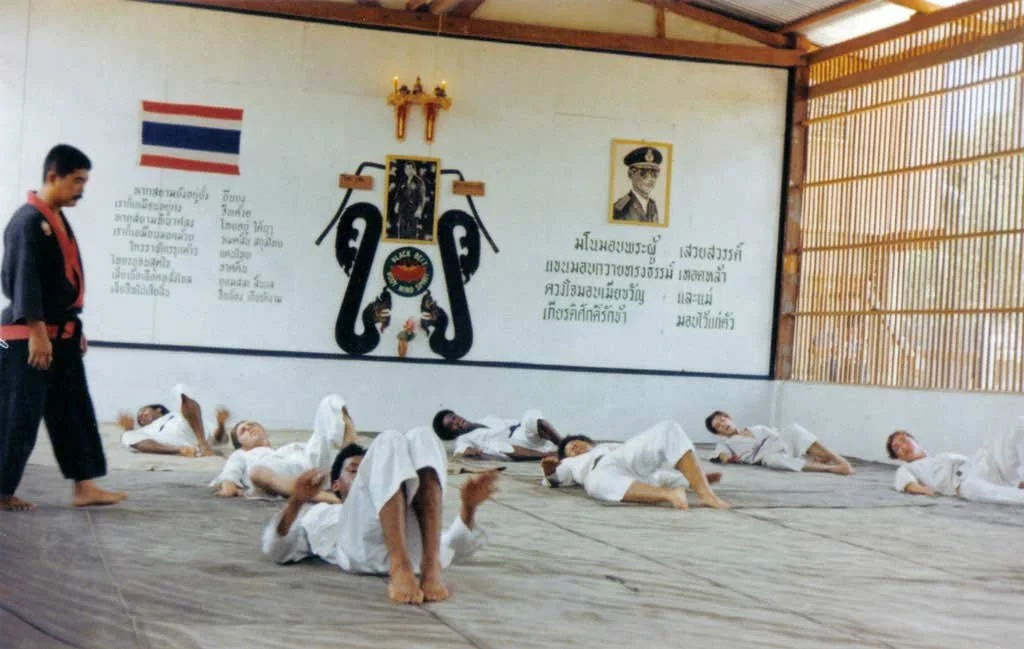
Ajarn Preecha leading class at the original Lotus school in Ubon Ratchathani, Thailand in the early 1970s.
Lotus Kajukenbo
Lotus Kajukenbo (aka “Lotus”) was created by Ajarn Preecha Mahachanavong and is part of the Kajukenbo family tree under Senior Grandmaster Tony Lasit. Ajarn (Thai for “head teacher” or “schoolmaster”) Preecha was a champion Muay Thai kickboxer in the 1950s who later earned his black belt in Kajukenbo under Senior Grandmaster Lasit, a first generation Kajukenbo student stationed on the US Air Force base in Ubon Thailand in the late 1960s. When he departed on a tour of duty, Senior Grandmaster Lasit asked Ajarn Precha to take over the school.
Subsequently, Ajarn Preecha integrated additional techniques from Muay Thai and Aikido alongside Thai cultural elements to create Lotus as its own distinct style within the Kajukenbo family tree. Lotus eventually became officially sanctioned under the Thai Ministry of Education; for a time plans were underway to designate Lotus as the national martial art of Thailand.
In 1974, Roy Harrington took up studies at the Ubon Lotus school while stationed at the Air Force base, and was ultimately transferred back to the US just before taking his brown belt test. Through a turn of fortune, Roy was close enough to train with Robert Price — the first American to earn a Lotus black belt and founder of the first Lotus school in the US — under whom he earned his brown belt. Upon leaving the USAF in 1976, Roy moved to Spokane, Washington where he completed his black belt test in 1978 under Lotus instructors Chuck and Lily Quick. He then took over the Spokane Lotus program in June 1979 when Chuck and Lily moved to Bend, Oregon to open a new Lotus program there.
Ajarn Roy continued to grow the Spokane program into Lotus Self Defense Academy, the flagship Lotus school in the US, where Yoshi Silverstein (Head of Studio Mitsui) began Lotus studies in 1988. Yoshi earned his first degree black belt in 2001, during his senior year of high school. He was also a founding member of the Lotus Kickboxing Competition team with an undefeated kickboxing competition record. Started in 1996, the Lotus team was foundational to seeding the Muay Thai and American Kickboxing competition scene that thrives to this day in Spokane.
Ajarn Roy spent the summer of 2003 studying with Ajarn Preecha in Thailand and invited any of his black belts who could to join. Yoshi joined these studies for a brief period, alongside his mother Pam (also a black belt) and sister (brown belt at the time, now a black belt). That summer, Ajarn Roy was awarded his 6th degree black belt directly from Ajarn Preecha; and Yoshi was also awarded his second degree black belt.
In 2006, Senior Grandmaster Tony Lasit visited the Spokane Lotus school to observe and share his teaching. Impressed by what he saw, the visit culminated in a night of promotions during which Ajarn Roy was awarded an 8th degree “professor level” black belt from Senior Grandmaster Lasit, who also signed promotion certificates for a number of other Lotus black belts (included Yoshi).
In 2024, Ajarn Roy retired from his position as head of school and passed ownership to his oldest son Ajarn Gabriel Harrington, who was also promoted to 5th degree black belt. Bringing fresh energy and rigor to the school, Ajarn Gabe continues to grow and strengthen the school in its latest phase of life.
Ajarns Roy and Gabe have both also studied other martial arts and bring that continued learning and evolution of the Lotus system into their teaching and practice — a spirit we very much honor at Mitsui Martial Arts. Today, while only a small number of Lotus schools exist around the country, Lotus is known for its high level of standards, versatility as a martial arts style, and commitment to ongoing learning and evolution. We are honored and grateful to teach Lotus in connection with our Lotus family in Spokane and around the country.
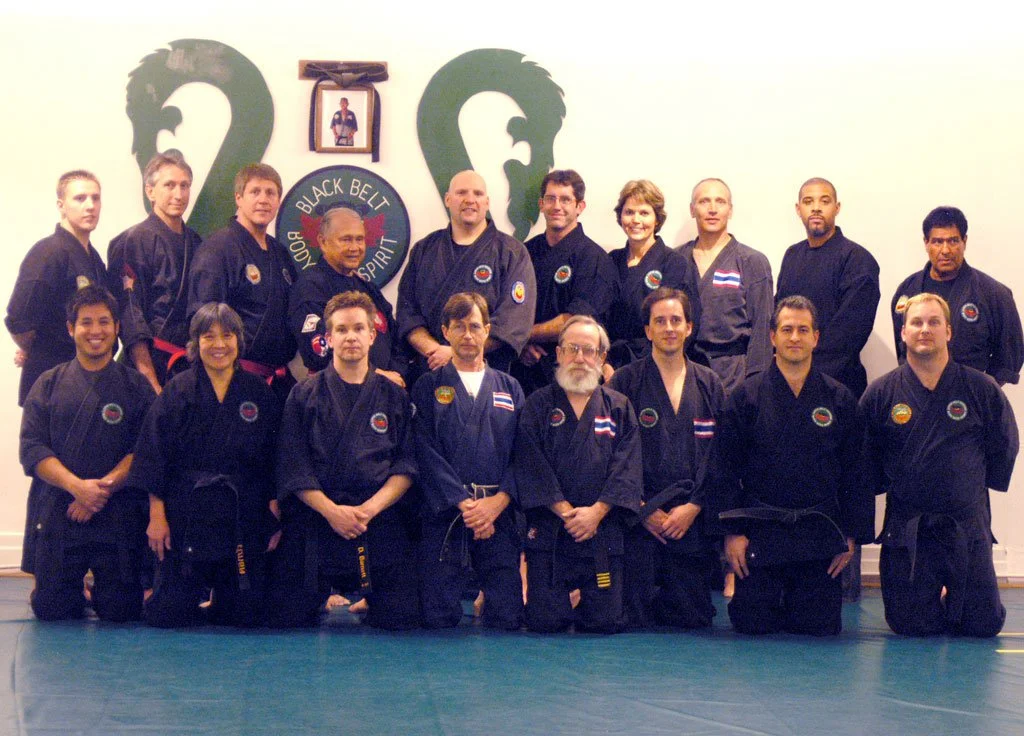
Lotus Kajukenbo black belts gathered from across the US with Kajukenbo Senior Grandmaster Tony Lasit (center) at the 2006 seminar and promotion ceremony at Lotus Self Defense Institute in Spokane, WA. Ajarn Roy stands alongside SGM Lasit (left in photo); Ajarn Gabe stands top left. Yoshi Silverstein (and his mother Pam Silverstein) are at bottom left.
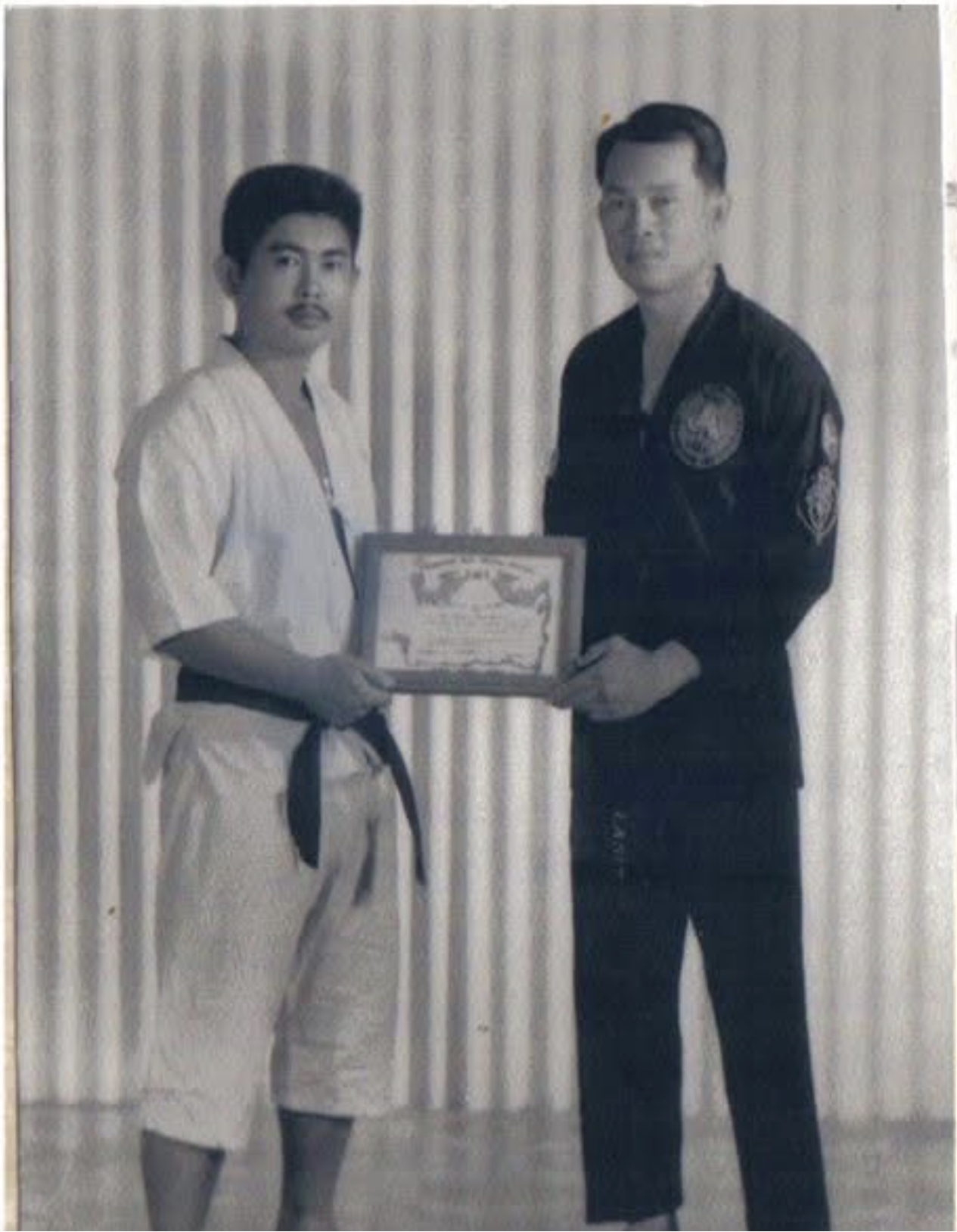
Kajukenbo Master Tony Lasit (right) presenting Ajarn Preecha Mahachanavong (left), founder of Lotus Self-Defense, his black belt certificate in Kenpo-Karate under the Kajukenbo System — Ubon Ratchathani, Thailand circa 1968.
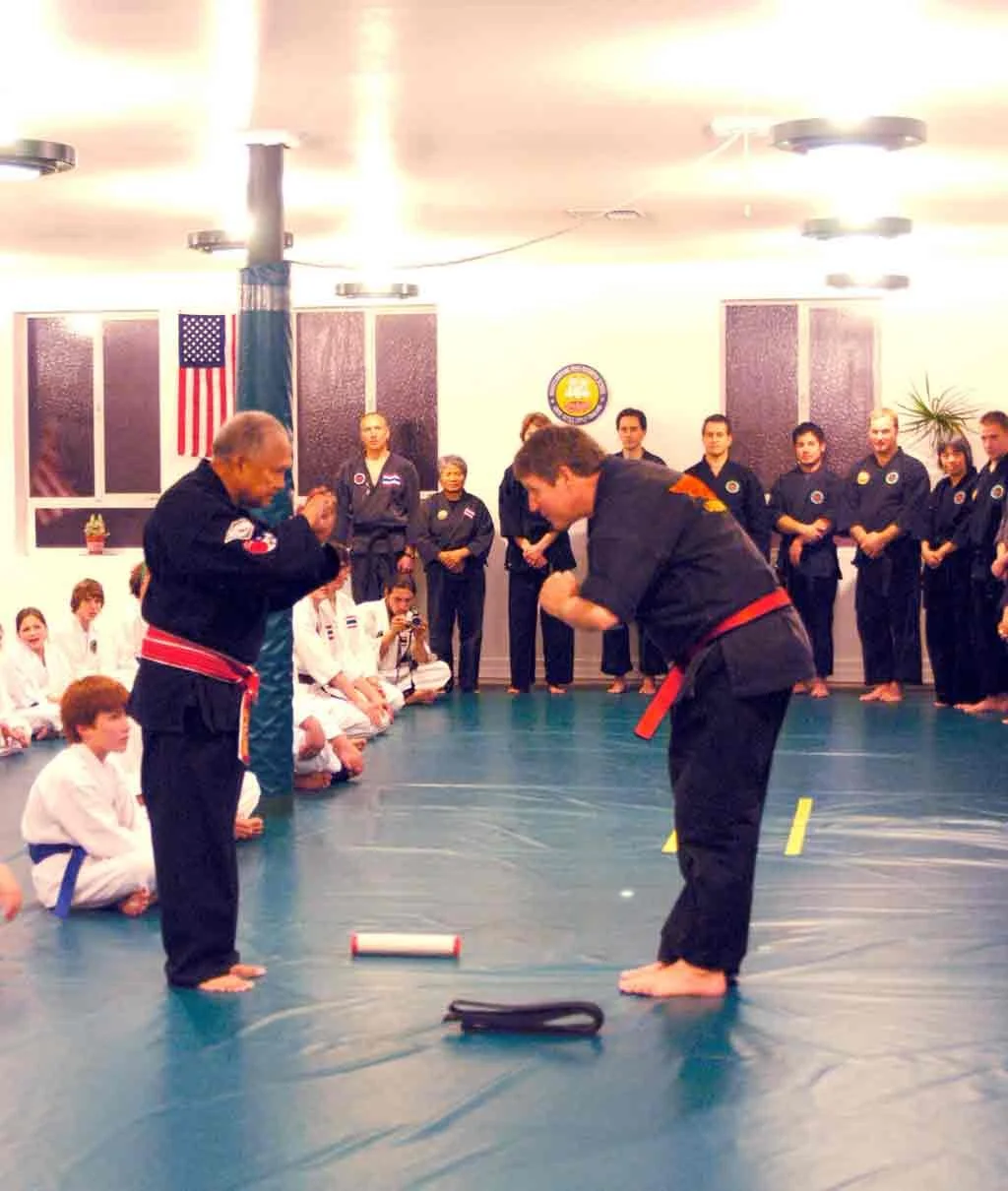
Senior Grandmaster Tony Lasit (left) presenting Ajarn Roy Harrington (right) with his 8th degree “Professor” rank in the Kajukenbo system — Spokane, WA 2006.
More about Kajukenbo
Kajukenbo is one of the world’s first intentionally “mixed” martial arts. A blend of Karate, Judo / Jujitsu, Kenpo, and Boxing (both Chinese and Western), it was developed in the late 1940s by a group of five senior black belts known as the “Black Belt Society” in the Palama Settlement of Hawaii.
The word Kajukenbo is derived from the first two letters of the martial art styles that contributed to the creation of the art. Together they make up the Kajukenbo motto: "Through this fist art one gains long life and happiness."
KA (long life) - comes from the word Karate, a Japanese martial art that places an emphasis on hard and powerful techniques such as punches and kicks. The karate influence was from Tang Soo Do brought by P.Y.Y. Choo.
JU (happiness) - comes from Judo and Jujitsu, Japanese martial arts that emphasize throwing, wrist and elbow joint locks and leg sweeps. The judo and jujitsu influence was from Kodenkan Danzan Ryu brought by Joe Holck and Se Keino Ryu brought by Frank Ordonez.
KEN (fist) - comes from Kenpo, a form of karate that not only stresses the hard and powerful movements of karate, but emphasizes multiple and fluid hand techniques. The kenpo influence was from Kosho Shorei Kenpo brought by Adriano Emperado.
BO (style) - comes from Chinese and American boxing. Chinese boxing (sometimes referred to as Kung Fu, though it is in fact a vast world of interconnected styles) puts emphasis on flexibility and agility, parrying and evasive movements that flow together. The Chinese boxing influence was primarily from Northern and Southern Sil-lum styles brought by Clarence Chang.
Tai Chi
While the earliest origins of Tai Chi are widely debated, its modern form can generally be traced to the Chen family in early 19th century China. Originally called Tai Chi Chuan (“Grand Supreme Fist”), Tai Chi is now practiced by millions of people worldwide and has become known for its health benefits and accessibility of practice for people of all ages.
At its root, Tai Chi is a martial arts style with deep emphasis on alignment of breath and body, powerful rooting, and circular movements — all of which serve both as beneficial practices on their own and as a valuable foundation for most any other martial arts style.
While related, the concept of taiji has its own ancient roots in Taoist philosophy. Taiji is a cosmological framework for understanding the states and energy flows of the universe — including the mutually reinforcing, codependent interactions between the two opposing forces of yin and yang. The well-known taiji symbol (also known as the yin and yang symbol) represents the dual, flowing nature of these complementary forces.
Tai Chi Chuan, the practice, can thus be understood as a system of embodiment designed to practice the application of these cosmological principles of energy flow in relationship to one’s self, others, and the entirety of the world around and within us.
Yang-style Tai Chi
Yang-style Tai Chi (the style we teach at Mitsui Martial Arts) is one of five primary families of tai chi, and one of the most popular forms of Tai Chi practiced today. It was founded by Yang Luchan, who studied under Chen Changxing starting in 1820.
At the heart of Yang Tai Chi is the 24-Form — a choreographed sequence of 24 individual postures (forms) practiced at the pace of a slow, moving meditation with one form flowing fluidly into the next. Each of these postures can also be practiced in isolation.
At Mitsui Martial Arts, our Yang style Tai Chi is taught in the lineage of Sifu Kwong Wing Lam. Born in Canton, China, he was a lifelong student and master teacher of Chinese martial arts, studying throughout China before moving to the US in 1965. Sifu Lam died in 2018.
Mitsui Tai Chi is a direct affiliate of Two Tigers Kung Fu (Bedford, OH) under the instruction of Sifu Robert Fleming. Two Tigers is, in turn, part of a family of affiliated schools in Northeast Ohio overseen by Sifu John Ervin, who studied directly with Sifu Lam from his youth through adulthood in a range of Chinese martial arts styles — including Northern Shaolin and Northern Praying Mantis in addition to Tai Chi.
Qi Gong
Qi Gong — which can be more or less translated as “energy work” — can perhaps best be thought of as both a philosophy and a set of principles and techniques for working with the cultivation and flow of energy (Qi) through the body. The roots of Qi Gong in ancient Chinese culture extend back more than 2,000 years. While Qi Gong can also be found in Taoist philosophy and practice, its use and application is not limited exclusively to Taoism.
Many Qi Gong techniques can be practiced on their own, and many of its principles and techniques can be found at the heart of many Asian martial arts systems — not surprising given its age and centrality to Chinese culture and traditions, and the ongoing exchange of ideas and practices across Asia.
As part of our Tai Chi curriculum, we teach and practice several specific Qi Gong techniques, including Invigorating the Spirit, and the Eight Brocades.
Principles, elements, and techniques of Qi Gong can also be found in a number of Mitsui Movement forms and practices.
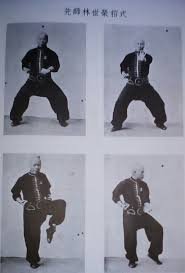
Sifu Kwang Wing Lam from a 1986 publication
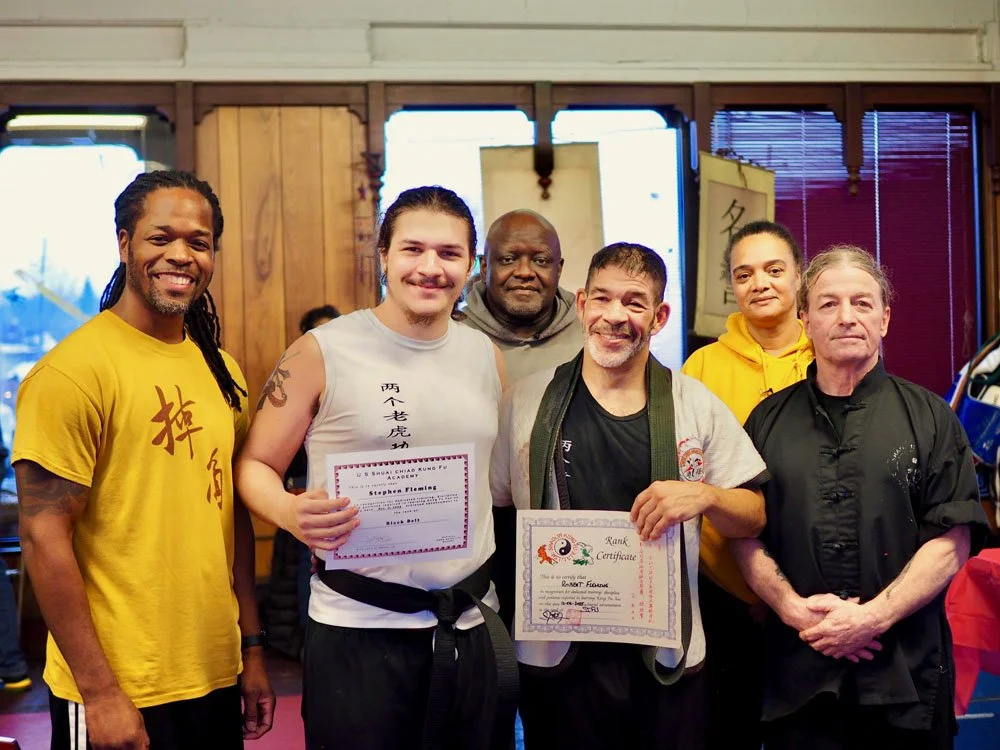
Sifu promotion ceremony for Robert Fleming at Two Tigers Kung Fu — November 2025.
Pictured (from left): Sifu Daniel Cliff, new black belt Stephen Fleming, Sifu John Ervin (back center), Sifu Robert Fleming (front center), Simu Alma Ervin (back right), Sifu Gino Belfiore.